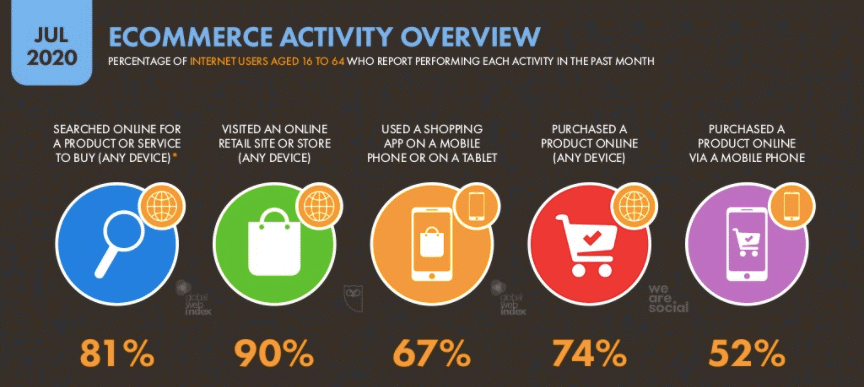
74% have purchased online via any device and 67% use mobile shopping apps.
Who has the biggest search engine market share worldwide?
Of course, Google continues to dominate search engine use, starting 2020 with an average net market share of 70.38% on desktop according to NetMarket Share. However, this figure is actually slightly below where it stood at the start of 2019 (75.46%) as another search engine www.bing.com enjoyed a slight increase in their net share.
Clearly, Google is the dominant market leader, which of course must be taken into account for your digital strategy, but other search engines, especially Bing and Baidu deserve consideration, each having more than a 10% market share.
It’s a slightly different story on mobile, however, as Google currently holds 93.87% of the market share. This is likely due to Google’s continued focus on the importance of mobile UX factors for SEO.
Desktop vs mobile vs tablet searches
Up until mid-2019, mobile and desktop searches were mostly neck and neck, with mobile just edging into the lead every few months. However, June 2019 saw mobile account for 50.71% of searches, with desktop dropping down to 45.53%.
Since this point, the gap between mobile and desktop searches has remained, with mobile becoming the top option for searchers. This shows that as more people remained connected 24/7 due to the high mobile phone penetration across the globe, desktop searches are likely to continue to decline.
In terms of the share of searches handled by tablets, these have seen a decline since the start of 2019.
As we can see, there have been changes in behaviour at key points this year – notably April 2020 which saw a huge number of technological, economic, and social changes due to the Coronavirus pandemic. Regarding audience device type, it seems to have been accompanied by an increase in mobile search.
The impact of mobile search on SEO
What does this change in search habits mean for SERPs? [Search Engine Ranking Placement]
At the moment, only 13% of websites are able to retain the same position for a particular search across all devices. So, you may be ranking well on desktop but not even appear on the first page of results on mobile. In fact, 30% of pages that show on the first page of desktop search results do not appear in the top
Do People Read?
Not as much as they used to. Mobile searchers prefer to click on a video rather than trying to read a small screen which produces another challenge.
You Tube is a search engine in itself – it just happens to be videos.
The growth in ‘How To’ searches is huge as people who would normally ask family, friends, etc., now ask YouTube. The importance of YouTube cannot be underestimated in terms of your marketing and you should always consider including YouTube in your multi-channel marketing campaign as an audio / visual message medium.
What is Absorbed?
Remember the established adage we remember
10% of what we read
20% of what we hear
30% of what we see
50% of what we see and hear
70% of what we discuss with others
80% of what we personally experience
95% or what we teach others
Edgar Dale
The difference in placement can best be illustrated by the distribution of winnings in a horse race.